Transformative Business Models

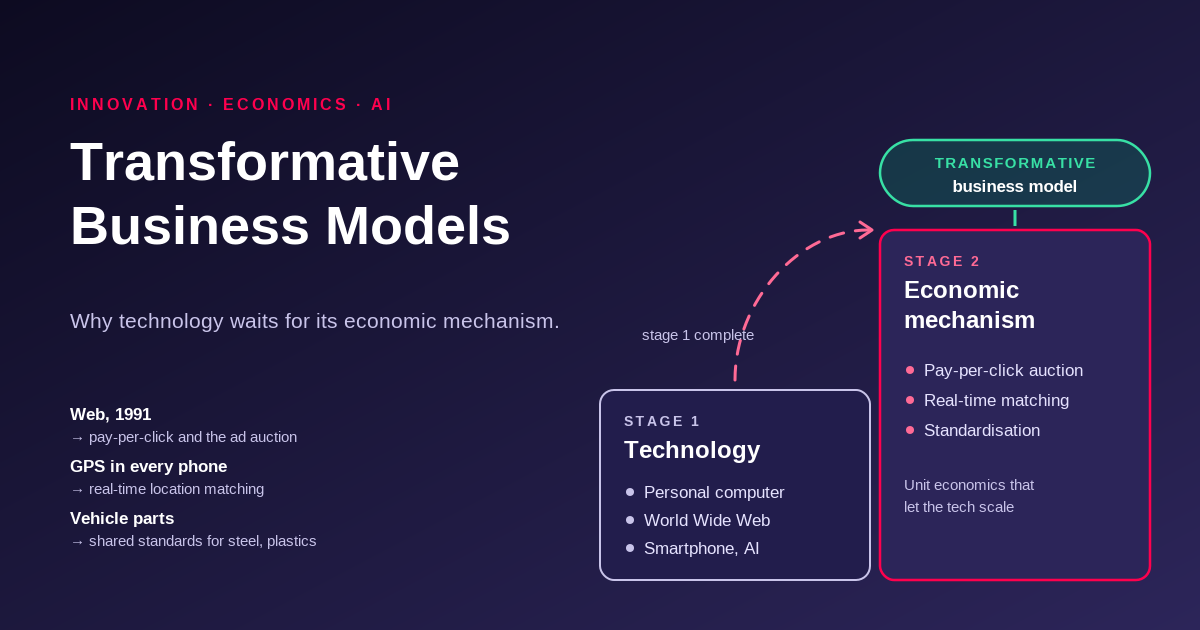
For developers and business leaders in Manufacturing, Supermarkets, Banking, Education, HealthTech, FinTech and Tax Returns, the pattern matters because it determines when an innovation becomes usable, affordable, and governable inside regulated, operations-heavy environments.
The Two-Stage Process of Innovation
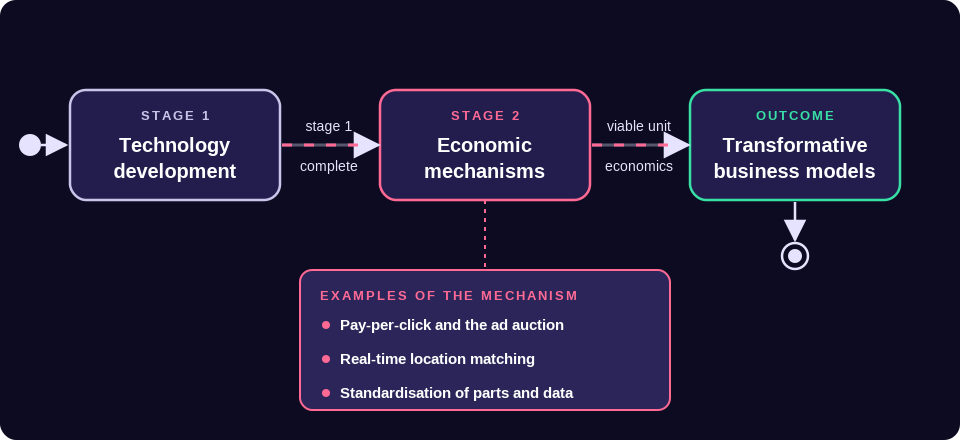
The current narrative in Silicon Valley is that the first wave has arrived. The development of new economic mechanisms is a two-stage process: the development of the technology itself and the development of new economic mechanisms that enable transformative business models. [1]
Every major technology wave arrives in two stages. [1] The first stage is the development of the technology itself: the personal computer, the World Wide Web, the smartphone, and now, generative and agentic and physical AI. The second stage involves the development of new economic mechanisms that enable transformative business models to take advantage of the technology. [1]
For sectors like supermarkets and tax returns, stage one is visible as pilots and proofs-of-concept. Stage two is what decides adoption: pricing models, data sharing contracts, liability allocation, and integration costs. A health system can run a generative model internally, but it will not scale until the economic mechanism — e.g., per-query pricing, model-as-a-service SLAs, or auditable usage metering — matches compliance budgets and risk tolerance.
The Rise of Web Advertising and the On-Demand Economy
The web was invented in 1991. But the web advertising economy didn’t really take off until Google figured out PageRank, and then perfected pay-per-click advertising and the ad auction. [1]
The web advertising economy didn't take off until Google perfected pay-per-click advertising and the ad auction. [1]
That second stage — an economic mechanism — is the template for developers today. Technology alone did not create the modern ad internet; a market design did. The same logic applies to on-demand services and to current AI adoption in regulated industries.
The smartphone put GPS in everyone’s pocket, but it wasn’t until Sunil Paul envisioned and built the first real-time location matching marketplace for ride sharing that Uber and Lyft and DoorDash were able to turn that capability into a huge on-demand economy. [1]
The smartphone put GPS in everyone's pocket, but it wasn't until Sunil Paul envisioned and built the first real-time location matching marketplace for ride sharing that Uber and Lyft and DoorDash were able to turn that capability into a huge on-demand economy. [1]
For banking and FinTech, the parallel is not ride hailing but real-time matching of supply and demand: instant lending, treasury cash pooling, or dynamic pricing for supermarket perishables. The developer implication is clear: building the sensor or model is 30% of the work. Building the matching, pricing, and settlement mechanism is the rest.
A simplified view of the auction mechanism that made web advertising scale:
# Pseudocode for a second-price pay-per-click auction
bids = [bidder for bidder in advertisers if bidder.is_eligible(query)]
if not bids:
  winner = None
  price = 0
else:
  bids.sort(key=lambda b: b.cpc_bid, reverse=True)
  winner = bids
  if len(bids) > 1:
  price = bids[1].cpc_bid
  else:
  price = getattr(winner, 'reserve_price', 0)
Developers in Education and HealthTech face the same choice today with generative tools: expose raw model access or wrap it in a governed, metered service with audit logs. Business leaders must price the service not by compute cost alone, but by value delivered per compliant interaction.
The Impact of Artificial Intelligence on Silicon Valley
Silicon Valley’s AI moment is hardware-led. NVIDIA announced the DGX GH200 AI supercomputer, a system aimed at the largest AI and data analytics workloads.
DGX GH200 supercomputers include NVIDIA software to provide a turnkey, full-stack solution for the largest AI and data analytics workloads. [2]
Google Cloud, Meta and Microsoft are among the first expected to gain access to the DGX GH200 to explore its capabilities for generative AI workloads. [2]
NVIDIA is building its own DGX GH200-based AI supercomputer to power the work of its researchers and development teams. [2]
NVIDIA DGX GH200 supercomputers are expected to be available by the end of the year. [2]
The hardware lineage matters for credibility. NVIDIA's founder and CEO Jensen Huang brought a DGX AI supercomputer to OpenAI in 2016, hardware that was ultimately used to build ChatGPT. [3]
For manufacturing and supermarkets, this means the compute base for training and inference is consolidating around a few full-stack vendors. That reduces integration risk but raises vendor concentration risk, cost predictability, and data egress concerns.
The impact is felt in inference efficiency. NVIDIA's new inference platform, NVIDIA L4, offers 120x more AI-powered video performance than CPUs, combined with 99% better energy efficiency. [3]
| Decision factor | DGX GH200 class | L4 class inference |
|---|---|---|
| Primary use | Largest AI and data analytics workloads | AI-powered video performance with energy efficiency |
| Software stack | Turnkey full-stack solution | Inference platform |
| Access | Cloud providers exploring generative AI workloads | Edge / data center inference |
Developers should map workloads to the right tier. Training and large-scale fine-tuning belong on DGX-class systems. Real-time assistive features in point-of-sale, call centers, or clinical triage often belong on efficient inference platforms.
Standardization Efforts in the Automotive Industry
Standardization is the second-stage economic mechanism applied to manufacturing. Toyota, Nissan, and Honda will begin standardizing some vehicle parts in an effort to lower production costs. [4]
The automakers will start with equalized quality criteria for steel, consistent protocols for plastics, and a universal color-coding scheme for wiring harnesses. [4]
The first standardization efforts are set to go into place next year, according to the AN report. [4]
The automakers are said to hope that they can channel the money saved by homogenizing into new innovations. [4]
For Manufacturing, Supermarkets, Banking, Education, HealthTech, FinTech and Tax Returns, the automotive example is directly relevant. Standardization reduces SKU complexity, simplifies procurement, and frees engineering budget for innovation.
In supermarkets, standardizing data schemas for suppliers — e.g., common product identifiers, nutrition facts, and freshness timestamps — reduces integration work for inventory and loyalty systems. In banking and tax returns, common data formats and API contracts reduce compliance engineering. In HealthTech, consistent device data models accelerate integration.
The implication for business leaders: standardization is not a technical nicety; it is a cost-to-innovation lever. For developers, it means prioritizing interoperability over bespoke features.
The Future of AI and Generative Workloads
Generative workloads are moving from experiments to production economics. The DGX GH200 announcement signals that the industry is preparing for sustained, large-scale generative AI workloads.
Google Cloud, Meta, and Microsoft are among the first expected to gain access to the DGX GH200 to explore its capabilities for generative AI workloads. [2]
The turnkey full-stack positioning matters: DGX GH200 supercomputers include NVIDIA software to provide a turnkey, full-stack solution for the largest AI and data analytics workloads. [2]
For the sectors addressed here, the near-term questions are not about model size but about governance and cost:
- How to meter generative use per customer or per transaction in FinTech and tax returns without leaking PII.
- How to ensure reproducibility and auditability in Education and HealthTech.
- How to balance latency and cost for real-time supermarket recommendations.
Developers should design for modularity: separate prompt construction, retrieval, generation, and post-processing, with clear observability at each stage. Business leaders should demand economic models that map to their own unit economics — per qualified answer, per compliant document processed, per reduced cart abandonment — rather than raw GPU hours.
Silicon Valley’s current state is a transition from technology creation to economic mechanism design. The opportunity for Manufacturing, Supermarkets, Banking, Education, HealthTech, FinTech and Tax Returns is to participate in stage two: shaping standards, pricing, and governance so that transformative business models fit operational realities rather than forcing operations to fit the technology.
References
- What Happened to Silicon Valley? – O’Reilly — oreilly.com
- NVIDIA Announces DGX GH200 AI Supercomputer — nvidianews.nvidia.com (29 May 2023)
- NVIDIA's big AI moment is here — engadget.com (21 March 2023)
- Toyota, Nissan, and Honda to Standardize Parts to Lower Costs — caranddriver.com