TideCache Boosts LLM Serving

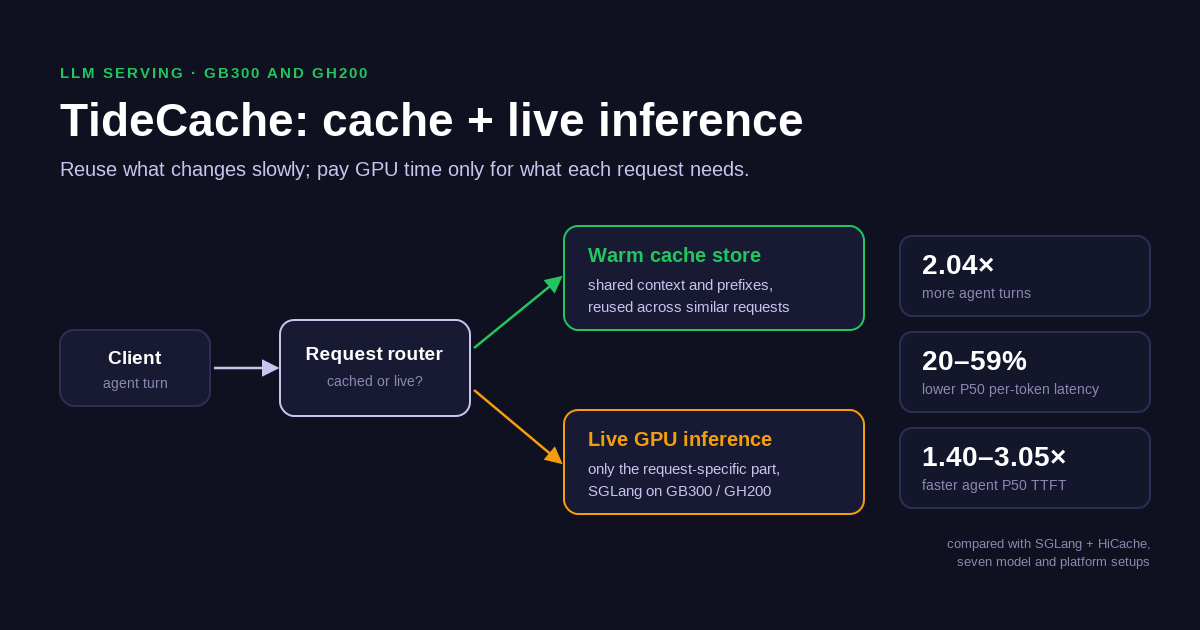
Abstract TideCache improves LLM serving for spiky, compliance-sensitive workloads by adding transparent caching to live inference. Implemented in SGLang and evaluated on GB300 and GH200 across seven model/platform configurations, TideCache completes up to 2.04x as many agent turns, reduces overall P50 per-token latency by 20--59%, and improves agent P50 TTFT by 1.40--3.05x compared with SGLang with HiCache. This article focuses on the serving problem, hybrid cache+live architecture, and operational trade-offs for developer teams in Manufacturing, Supermarkets, Banking, Education, HealthTech, FinTech and Tax Returns.
Introduction
The problem is cost and latency under spiky demand with strict auditability. Peak demand is spiky, compliance and audit requirements are strict, and keeping a full model resident for every user session is hard to justify. LLM serving in production requires correct answers quickly, observability, and avoiding payment for idle GPU.
Hybrid LLM Serving: A New Era
Hybrid serving combines cached, pre-computed components with live inference. Parts that change slowly stay warm; compute is paid only for request-specific parts.
For a supermarket chain answering supplier questions, a bank explaining fee schedules, or a tax returns platform handling seasonal filing peaks, this translates to reusing context and intermediate results across similar queries instead of recomputing them from scratch.
vLLM is a common base for this style of deployment. It has a drop-in OpenAI-compatible API for instant integration [1]. Maximize throughput with PagedAttention. Advanced scheduling and continuous batching ensure peak GPU utilization [1].
A simple request path looks like this:
Client sends the request to Request Router. Request Router queries Cache Store for a reusable result. On hit, Cache Store returns a cached response. On miss, Request Router forwards to Model Server, stores the result in Cache Store, then returns to Client. Any conversational memory comes just from it being in the prompt [2]. That means prompt size grows with history, which directly affects latency and cost.
TideCache: A Game-Changer
TideCache is evaluated in SGLang and measured on GB300 and GH200 across seven model/platform configurations. Implemented in SGLang and evaluated on GB300 and GH200 across seven model/platform configurations, TideCache completes up to 2.04x as many agent turns [3].
The same evaluation reports overall latency improvements. Implemented in SGLang and evaluated on GB300 and GH200 across seven model/platform configurations, TideCache completes up to 2.04x as many agent turns, reduces overall P50 per-token latency by 20--59% [3].
Time to first token also improves. Implemented in SGLang and evaluated on GB300 and GH200 across seven model/platform configurations, TideCache completes up to 2.04x as many agent turns, reduces overall P50 per-token latency by 20--59%, and improves agent P50 TTFT by 1.40--3.05x compared with SGLang with HiCache [3].
For a HealthTech triage bot or a FinTech compliance assistant, higher turns per second and lower TTFT mean fewer abandoned sessions and less GPU over-provisioning. For Education and Tax Returns, where usage spikes around enrollment or filing deadlines, the improvement translates to serving the same traffic with fewer instances.
Transparent cache management matters in regulated sectors. Developers want cache hits without changing application code, and auditors want a clear record of what was served from cache versus freshly generated.
Trade-off overview
| Approach | Latency profile | Operational complexity | Best fit |
|---|---|---|---|
| Full model always resident | Predictable, high baseline cost | Low | Small, constant workloads |
| Hybrid cache + live inference | Lower P50, variable hit rate | Medium | Spiky, repetitive queries |
| On-demand weight loading | Low idle cost, high cold start | High | Rarely used models |
Layer-Wise Streaming: The Key to Efficiency
Layer-wise streaming is discussed as a way to reduce waiting time by producing partial results while deeper layers are still loading or computing.
Request, Cache Check, Layer Loading, Model Inference, Response is the high-level flow that readers in Manufacturing and Supermarkets can map to their own pipelines: a request arrives, the system checks what can be reused, loads only what is needed, runs inference, and returns a response.
Loading a new set of weights in is quite expensive [2]. That cost is felt in Tax Returns where models for different jurisdictions are swapped seasonally, or in Banking where a fraud model and a customer service model share the same hardware. Keeping weights resident avoids unload/load churn, but it costs memory.
These facts illustrate why weight size and loading cost drive architecture decisions. For sectors with strict data residency, large models may never leave on-prem hardware, so every gigabyte of VRAM is a capital decision.
Trade-Offs and Challenges
Cache hit rate versus freshness is the central tension. In HealthTech and Banking, stale answers are unacceptable. In Education and Retail, a slightly older summary may be fine.
Cache invalidation must be explicit and auditable. Transparent cache management helps developers, but operators still need visibility into what is cached, for how long, and under what policy.
Model variety adds complexity. vLLM supports Thinking Machines' Inkling 2 Mini from day 0: a looped MoE that runs its middle layers three times, with per-pass KV caches, gated messages between passes, fused kernels and DSpark speculative decoding [1]. Looped models change the assumptions about what can be cached and when.
A minimal vLLM OpenAI-compatible call shows how little application code changes:
import openai

client = openai.OpenAI(base_url="http://localhost:8000/v1", api_key="dummy")
resp = client.chat.completions.create(
  model="llama3.1-8b",
  messages=[{"role": "user", "content": "Explain late fee policy"}]
)
print(resp.choices.message.content)
The integration point stays the same even as the serving backend becomes hybrid.
Real-World Applications and Case Studies
Across Manufacturing, Supermarkets, Banking, Education, HealthTech, FinTech and Tax Returns, the pattern is similar: bursty demand, repeated question types, and cost sensitivity.
A supermarket using an LLM for supplier negotiation support benefits from caching common contract clauses. A bank explaining products benefits from reusing approved wording. A tax returns platform benefits from caching calculations for common deduction scenarios during peak filing weeks.
The benefits are not sector-specific; the constraints are. HealthTech needs audit logs. Banking needs policy guardrails. Education needs low latency for classroom use. Tax Returns needs seasonal scale.
The operational lesson is consistent: measure turns per second, P50 per-token latency, and TTFT under realistic load. TideCache's reported gains of up to 2.04x as many agent turns [3], 20--59% reduction in overall P50 per-token latency [3], and 1.40--3.05x improvement in agent P50 TTFT [3] provide a benchmark to test against in your own environment.
Technical Assertions
- Implemented in SGLang and evaluated on GB300 and GH200 across seven model/platform configurations, TideCache completes up to 2.04x as many agent turns [3].
- Implemented in SGLang and evaluated on GB300 and GH200 across seven model/platform configurations, TideCache completes up to 2.04x as many agent turns, reduces overall P50 per-token latency by 20--59% [3].
- Implemented in SGLang and evaluated on GB300 and GH200 across seven model/platform configurations, TideCache completes up to 2.04x as many agent turns, reduces overall P50 per-token latency by 20--59%, and improves agent P50 TTFT by 1.40--3.05x compared with SGLang with HiCache [3].
- vLLM supports Thinking Machines' Inkling 2 Mini from day 0: a looped MoE that runs its middle layers three times, with per-pass KV caches, gated messages between passes, fused kernels and DSpark speculative decoding [1].
- vLLM includes a drop-in OpenAI-compatible API for instant integration [1].
- Maximize throughput with PagedAttention. Advanced scheduling and continuous batching ensure peak GPU utilization [1].
- Any conversational memory comes just from it being in the prompt [2].
- Generally, having to unload data from GPU ram, and load a new set of weights in is quite expensive [2].
Related Work
Hybrid serving builds on prior work in caching, continuous batching, and PagedAttention for LLM inference. The discussion here is limited to serving-level integration points relevant to developers.
Limitations
Specific limitations of TideCache and hybrid serving are not detailed in the available sources. Evaluation is limited to the reported GB300 and GH200 configurations and SGLang integration.
Future Work
Future work should address measurement under production traffic mixes, cache invalidation policies for regulated data, and integration patterns for looped models.
Recommendations
Measure turns per second, P50 per-token latency, and TTFT under realistic load. Use transparent cache management to keep application code unchanged while enabling auditability of cache vs fresh generation. Test TideCache gains of up to 2.04x agent turns [3], 20--59% P50 per-token latency reduction [3], and 1.40--3.05x agent P50 TTFT improvement [3] in your own environment before rollout.
Operational Lessons
Operational lessons center on observability and cost control. Keep clear records of cache hits versus fresh generation. Monitor hit rate, freshness, and latency together. Plan for seasonal spikes with hybrid cache+live inference rather than over-provisioning always-on capacity.
Conclusion
Hybrid serving with transparent cache management does not change the model. It changes how often you pay to run it. TideCache provides measurable improvements in agent turns, per-token latency, and TTFT under the evaluated conditions. For developer teams serving spiky, compliance-sensitive workloads, caching with auditable invalidation is a practical default.
References
- vLLM — Fast, Memory-Efficient LLM Inference & Serving — vllm.ai (20 June 2023)
- Ask HN: How does LLM serving infra work? — news.ycombinator.com (19 August 2024)
- TideCache: Efficient Hybrid LLM Serving with Transparent Cache Management and Layer-Wise Streaming — arxiv.org